Ideas to Pages
saloniagrawal • July 27, 2025
Nine months ago, I wrote a series of seven emails. They were my personal notes on a unique way of writing, found in Herbert Watson's 1922 book, Applied Business Correspondence.
So far, only a select few have seen these emails - yet I think they hold tremendous value and can teach a great deal about writing in very little time.
That's why I decided to reproduce the entire series here - on my personal blog. I hope you enjoy it!
Ideas to Pages (Start Here)
Thanks so much for raising your hand and expressing interest in Ideas to Pages. It's December 20th, and as promised, here's your quick intro to this mini-course.
Ideas to Pages is built on a framework I developed by connecting the dots between dozens of great (and some lesser-known) books, articles and newsletters. It's the most effective way I know to:
• Express a feeling or idea in words, and turn unorganized ideas into polished pages ready to be published.
• Get rid of the "Blank Page Syndrome" and finally know exactly what to write (and how).
• Write persuasively, in a way that grabs people's attention and establishes you as a skilled communicator.
It has that wonderful combination of higher-level theory / principles, and the handy tactics, practices, habits, and frameworks required to produce high-quality writing.
Later today you’ll receive the first of seven emails, followed by emails 2 - 7 daily, starting tomorrow.
Each email will take no longer than five minutes to read. I want these ideas to be accessible to you while respecting your time.
One more thing: This series isn't just text. As you'll see, I've included a bunch of visualizations to make everything easier to grasp.
Ideas to Pages is free (for now). Consider it a little "thank you" for being one of the early birds - a year-end gift from me to you.
Enjoy, and if you have any questions along the way, reply to any email and let me know.
—Saloni
ITP: The Missing Ingredient (email 1 of 7)
Hey, it's Saloni...
Welcome to Ideas to Pages 👋
(By the way, ITP is a shorthand for Ideas to Pages. I'll prepend it to the subject of all the emails in this series for your benefit.)
Many of the ideas I'm sharing throughout this series are inspired by a rare, yet incredible book from 1922 - called Applied Business Correspondence.
This book gave me a ton of "ah-ha" moments. For one, I realised that I didn't have to be intimidated by the blank page - that structuring my ideas on paper was surprisingly... simple - and that I could actually write well.
If you're at all similar to me, this may resonate with you.
When you understand, internalize, and implement what I share in this series, everything can change. And I don't say that lightly.
Let's begin...
[...]
What's the first step in writing any message?
It's knowing exactly what you want to achieve before you start. Think of it this way: When we write, our goal is to:
Take what we know, see, believe, feel, or want…
...and put it into words that will be read, understood, believed, agreed with, and acted upon.
This process requires forethought. It requires a plan.
[...]
This is the absolute first step.
Before you write a single word, you must determine:
- How likely is this person to even read your message?
- How hard will it be for them to understand it?
- How readily will they believe you?
- How quickly will they agree with you?
- And how likely are they to actually act on your message?
Only after addressing all of these components can you achieve a complete and effective piece of writing. One that actually connects.
This is especially true for marketing messages, but it applies to everything - emails, presentations, even just talking to people.
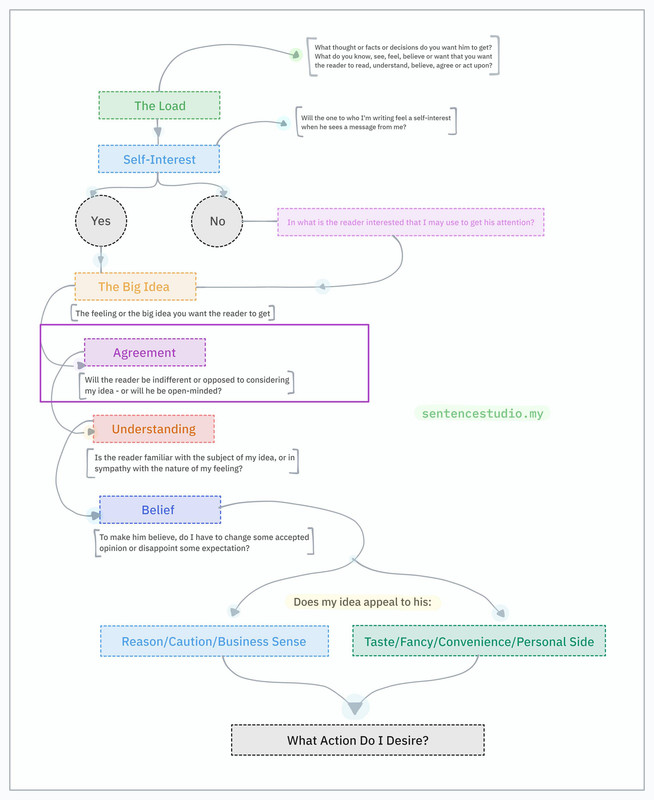
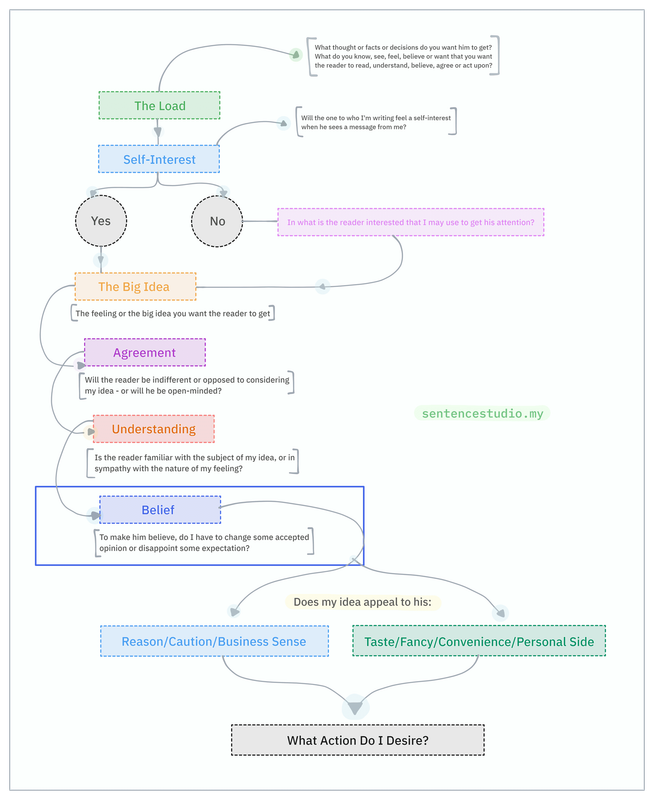
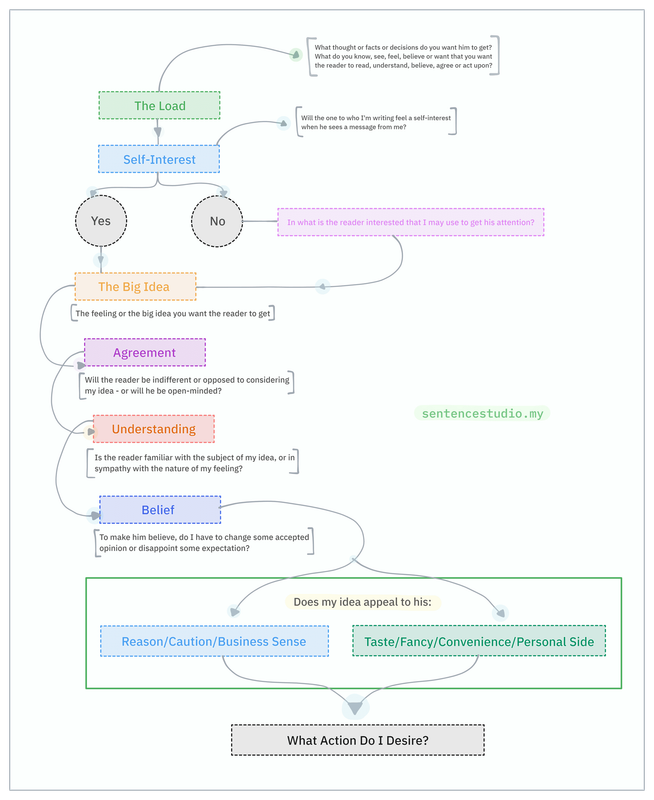
To make this crystal clear, I created a higher-fidelity visualization (start at the top):
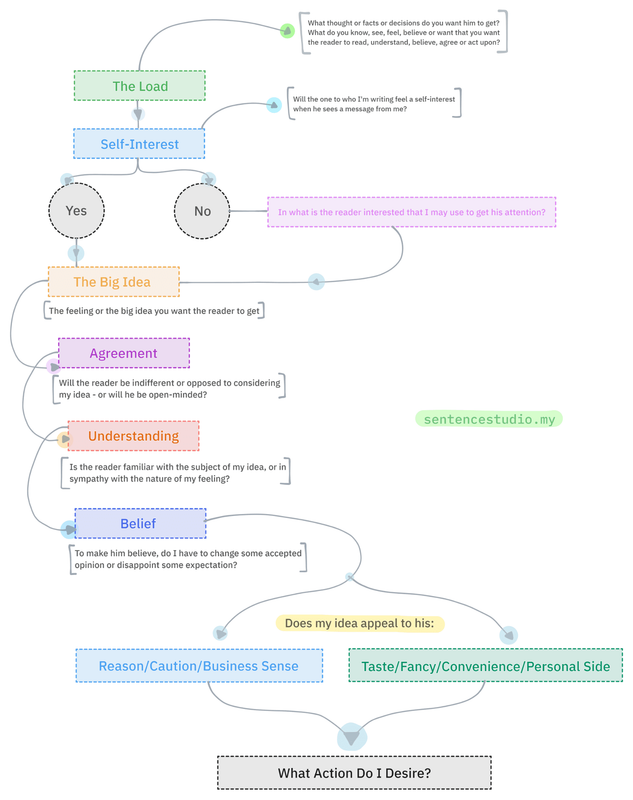 This visualization starts at the top
I know what you're thinking.
This chart looks complicated. Too “ginger-bready.”
But if you give it a chance - and just bear with it for a bit - you’ll quickly see how simple it really is (and how much it can improve your writing.)
I’ve put together a PDF with some examples of how this works in practice. It'll show you exactly how to use this chart to size up your own messages.
Study these examples closely. By the end, you’ll have a crystal-clear, high-level view of every single component.
[...]
This first step - sizing-up your message - is very, very, very important. If you get this right, everything is easier. If you don't, nothing is easy.
Over the next six days, we'll explore each of those individual components step-by-step, with the help of examples and visuals. This changes everything.
Enjoy your weekend!
—Saloni
P.S.
Let's cover some key writing best practices early on in this series.
Alex Busson’s article 9 Rules for Better Writing is a great place to start. It's a quick breakdown of the core ideas in Strunk & White’s The Elements of Style.
P.P.S.
Tomorrow… I’m revealing this one key insight.
It’s ridiculously simple - almost embarrassingly so.
Yet, if you just did this one thing, you’d wonder why you ever even stressed about blank pages. It would just… cease to be a problem.
I'll explain how to add that step to your writing process tomorrow.
Make sure you bring your crayons.
See you then...
ITP: A Myth Called Writer's Block (email 2 of 7)
Hey, it's Saloni...
This is the second email for this seven-part mini-series about writing frameworks. Check out Part I - The Missing Ingredient - if you haven't already.
Today, we'll be working with the Big Idea component of the size-up chart:
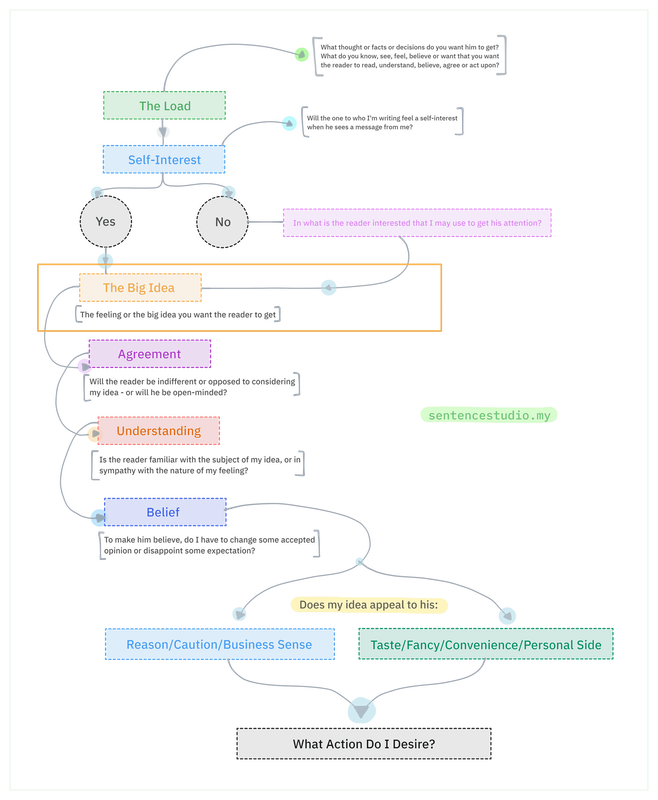 Use this chart to size up your piece of writing.
You sit down to write.
Ideas start popping into your head.
Those ideas lead to more ideas.
You try to make sense of it all, to piece everything together. After a while, you realize it's a mess and begin editing. It's a constant back-and-forth of adding, deleting, and tweaking.
Before you know it, exhaustion and frustration set in.
[...]
There's a simple reason why this happens. It's not because you're a bad writer. It's because you skipped a crucial step: outlining.
If you don't outline, your writing might be missing crucial pieces. Or, just as likely, it could end up with a bunch of stuff it doesn't need.
Outlining saves us from this headache.
[...]
So, how do you actually build an outline?
Start with your Big Idea - the core idea/feeling you want to convey. Then, pick a few leading features, and simply describe them from the basis of the Big Idea.
You see, merely asserting facts or features in your writing is not enough. Good pieces of writing make us see the idea or get the feeling. Often, a central Big Idea runs throughout the message:
Unless your advertising contains a big idea, it will pass like a ship in the night.
–David Ogilvy
Study the examples below closely. See how, by connecting features to the underlying idea or feeling, the writing flows almost naturally.
(A quick note: these examples are from a 1922 book, as previously mentioned. So please focus on the technique, and not the writing style.)
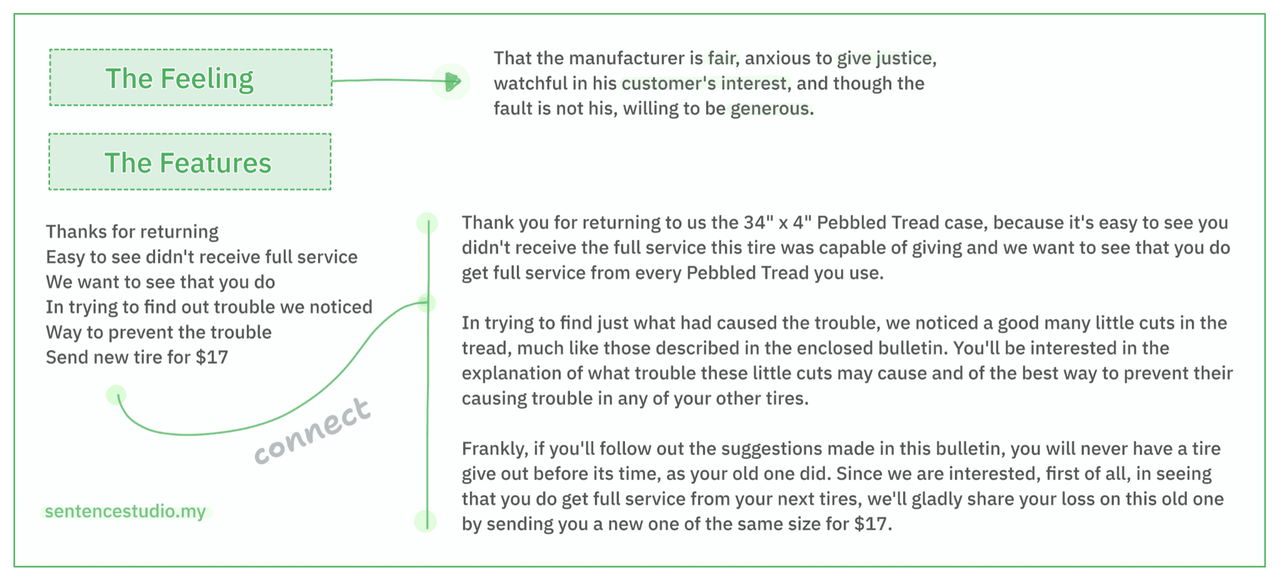 How do you handle a complaint when the customer is at fault?
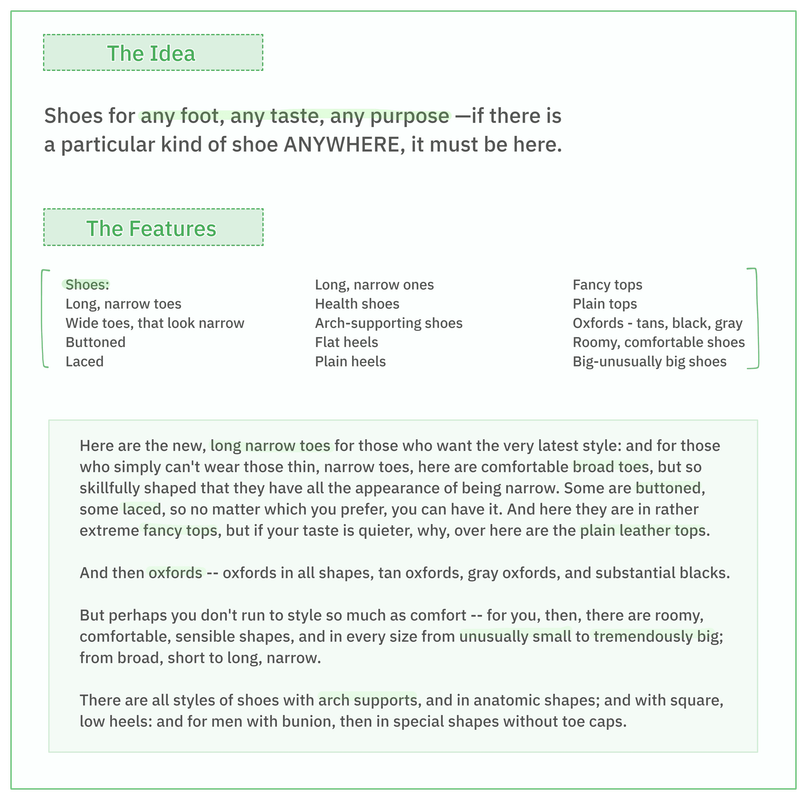 Notice how this letter conveys ONE BIG IDEA.
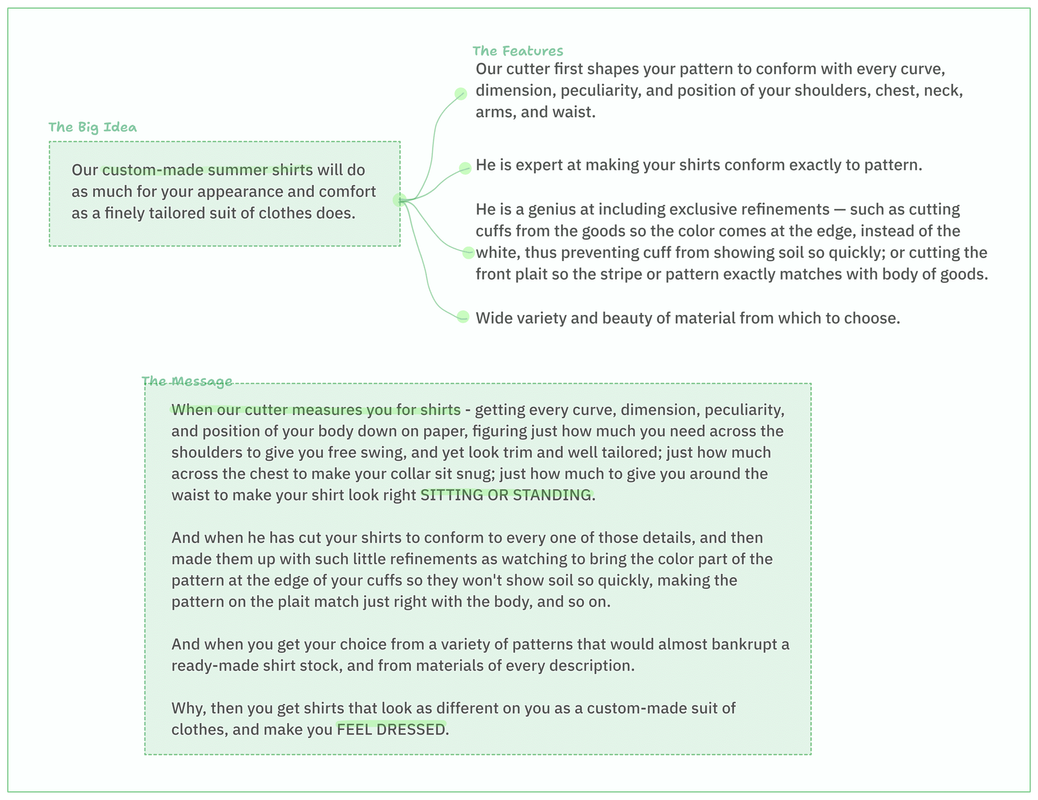 Write the features, not merely by themselves, but as part of the Big Idea.
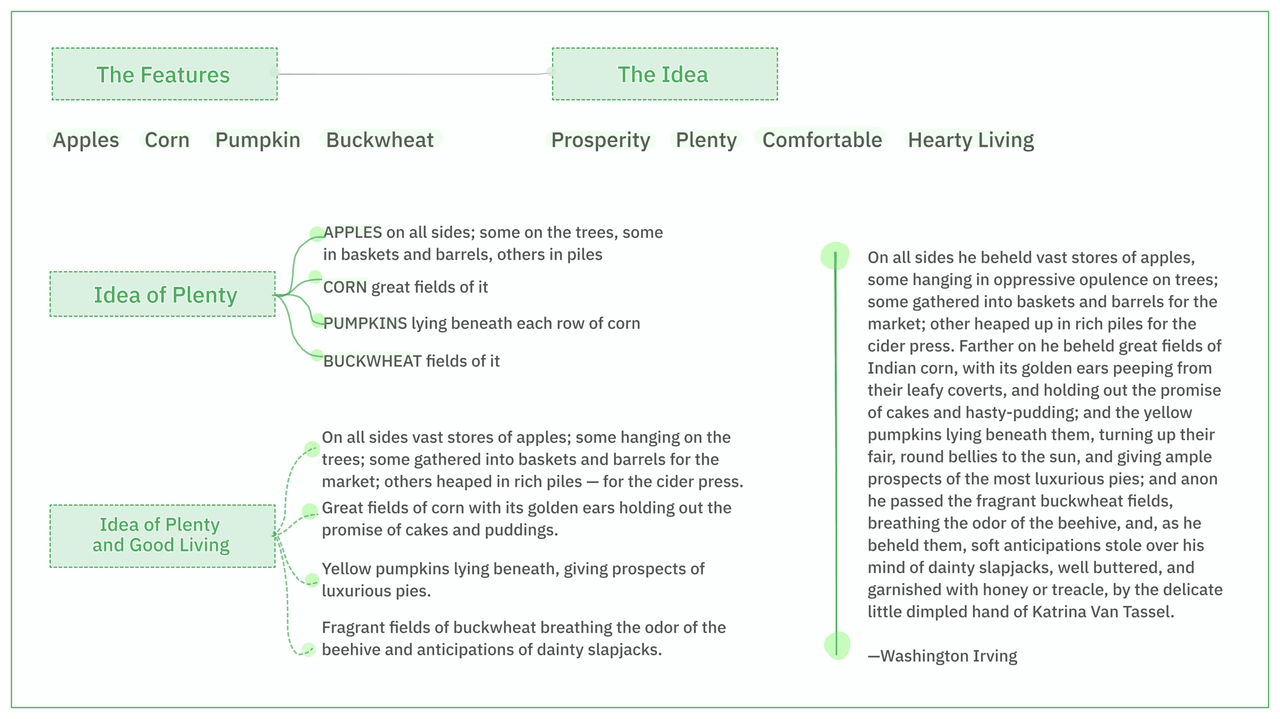 A classic example of how easily and naturally writing flows when features are simply listed.
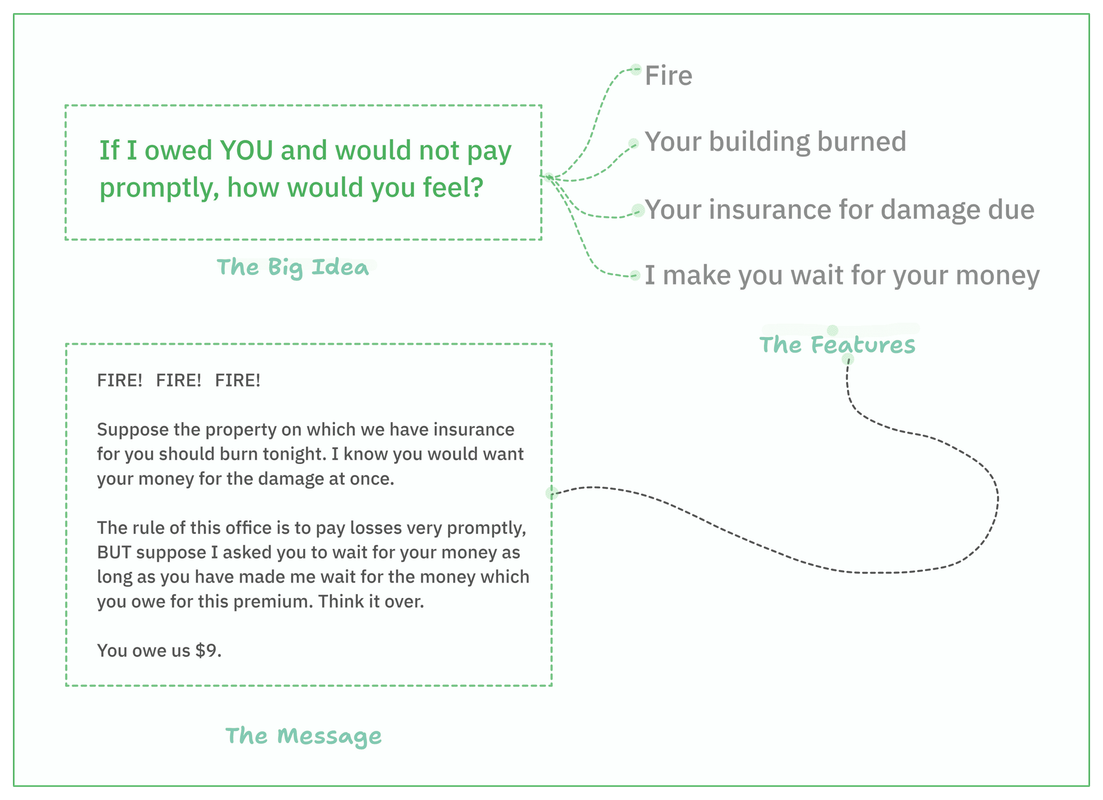 A simple letter from an insurance firm, asking for payment of dues.
Even the best chefs benefit greatly from having their ingredients ready.
Without preparation, the process is messy and takes a lot of effort. But when everything is prepped and organized beforehand, that same dish - even in the hands of a newbie - can be so much tastier.
Writing is no different. The outlining process you just learned - is like that prep work. It makes writing much easier. With a good outline, you won't get stuck staring at a blank page. You'll know exactly what to write next.
That said...
Not all good writers (or speakers) go through every part of this process. To some people, this visualizing process is intuitive. They do it unconsciously.
However, people who don't have this intuition can create it by practicing this process. In time, you'll train your mind to work that way unconsciously.
[...]
All good. By outlining, you can express your ideas and feelings with ease. But what happens when your reader is indifferent, or even worse, opposed to considering your idea?
More on that tomorrow...
—Saloni
ITP: The Connecting Link (email 3 of 7)
Hey, it's Saloni...
This is the third email for this seven-part mini-series about writing frameworks. Check out Part I and Part II if you haven't already.
Today's email covers the Agreement part of our framework:
When your reader is indifferent, or worse, opposed to considering your idea, how do you move forward? These visualizations show you:
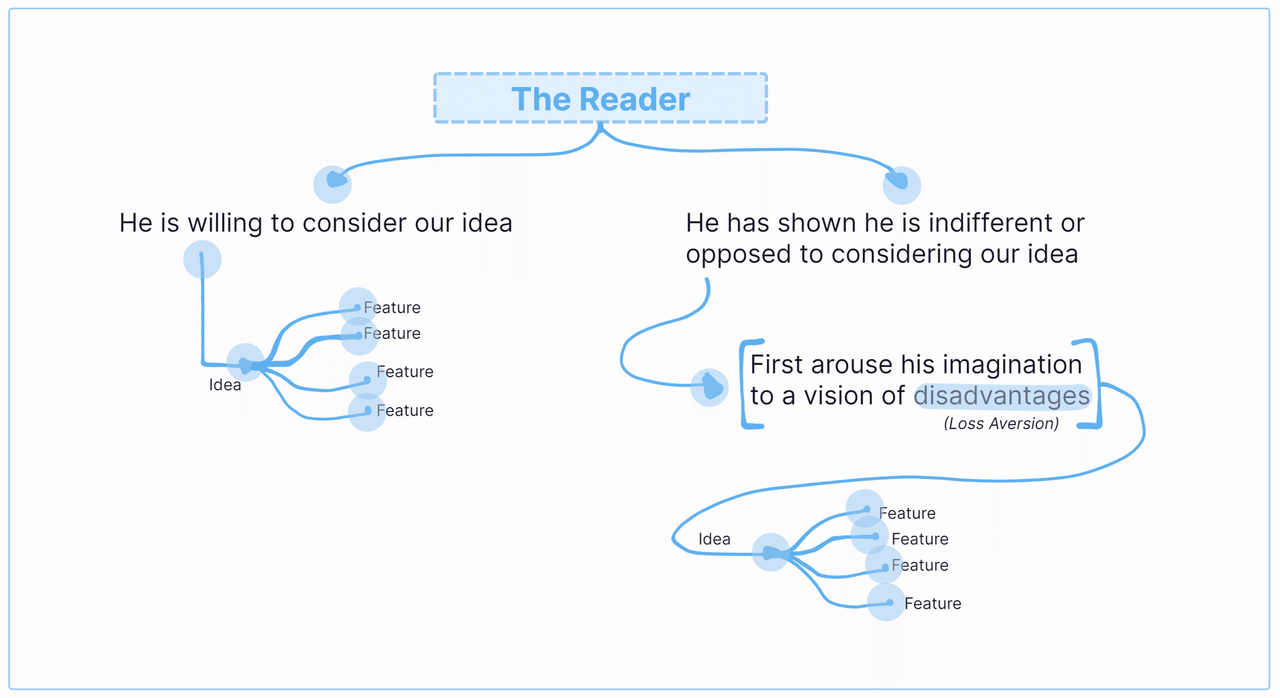 When your reader just doesn't care - or worse, disagrees - you need something more.
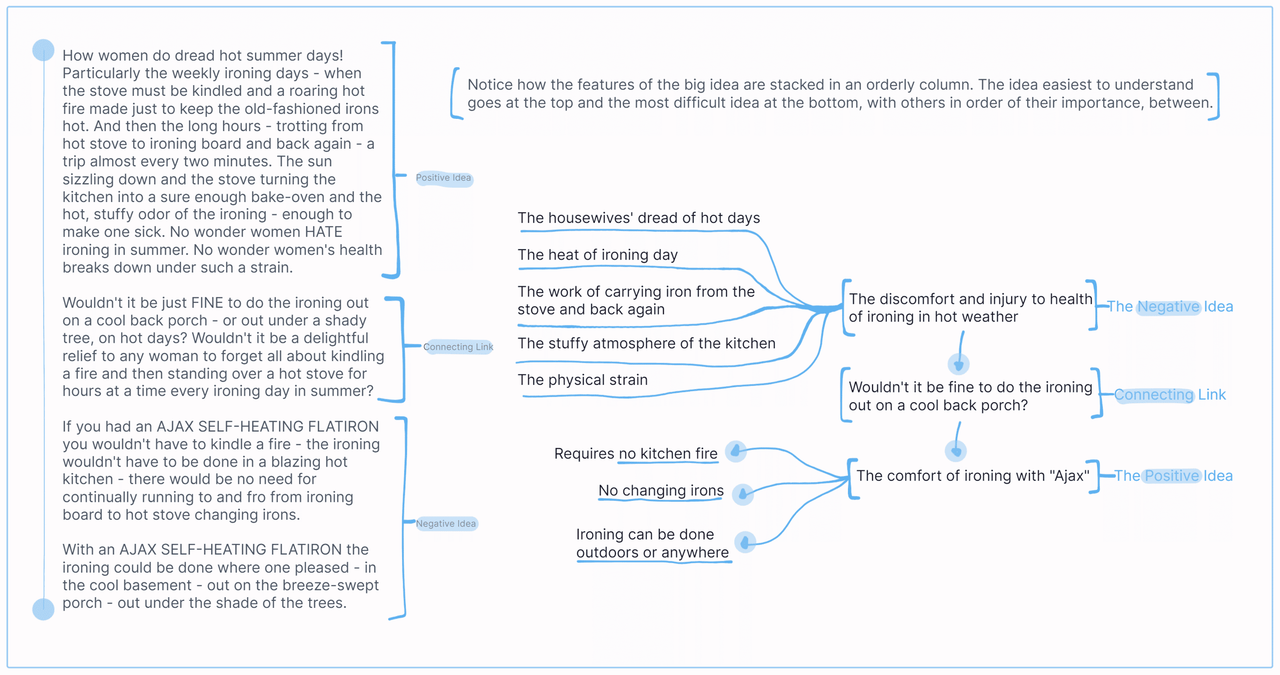
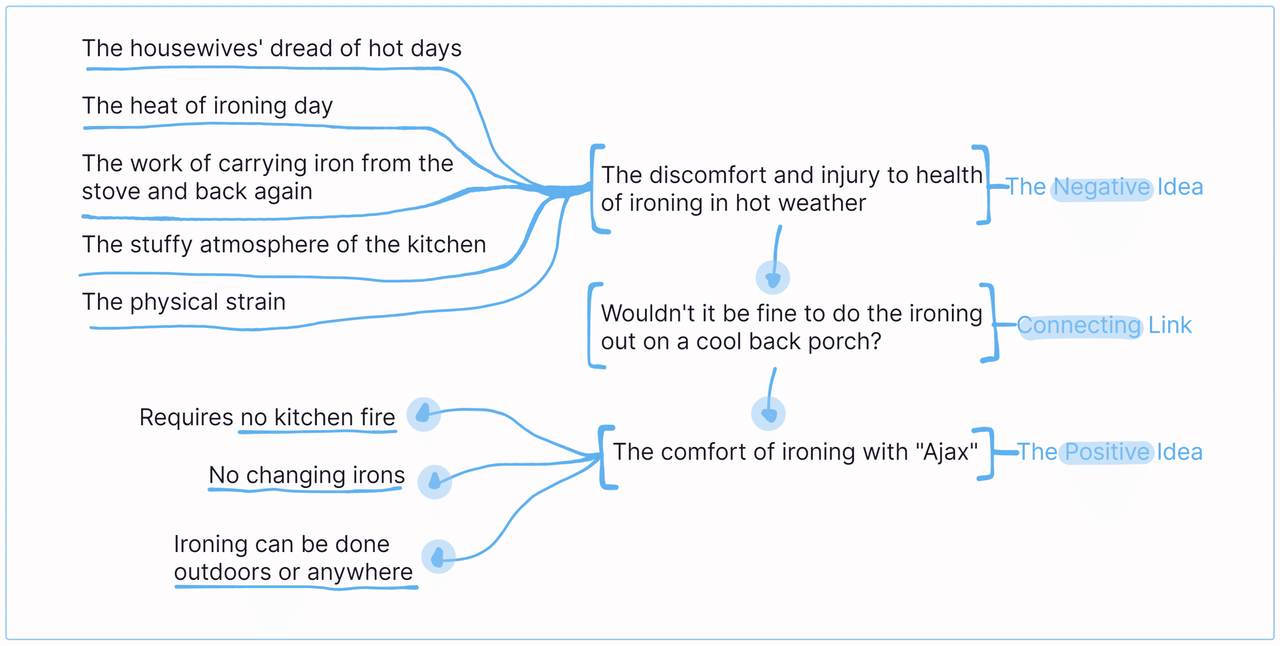 Notice how the writer paints a picture of "disadvantages," then smoothly connects it to a positive idea.
One more visualization that’ll help if you write marketing follow-ups:
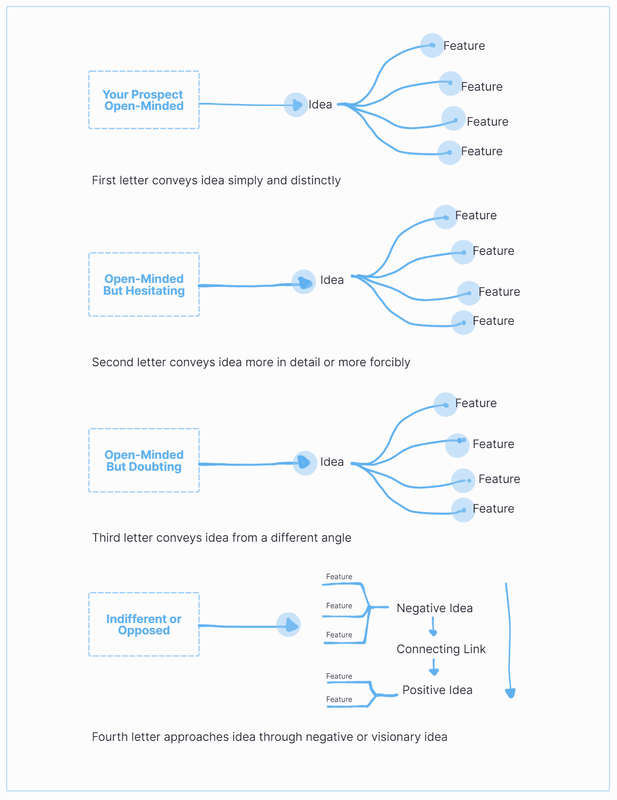 Each follow-up must present something new. It's a mistake to repeat the same ideas.
Here's another example, showing a how even a visionary idea can be used:
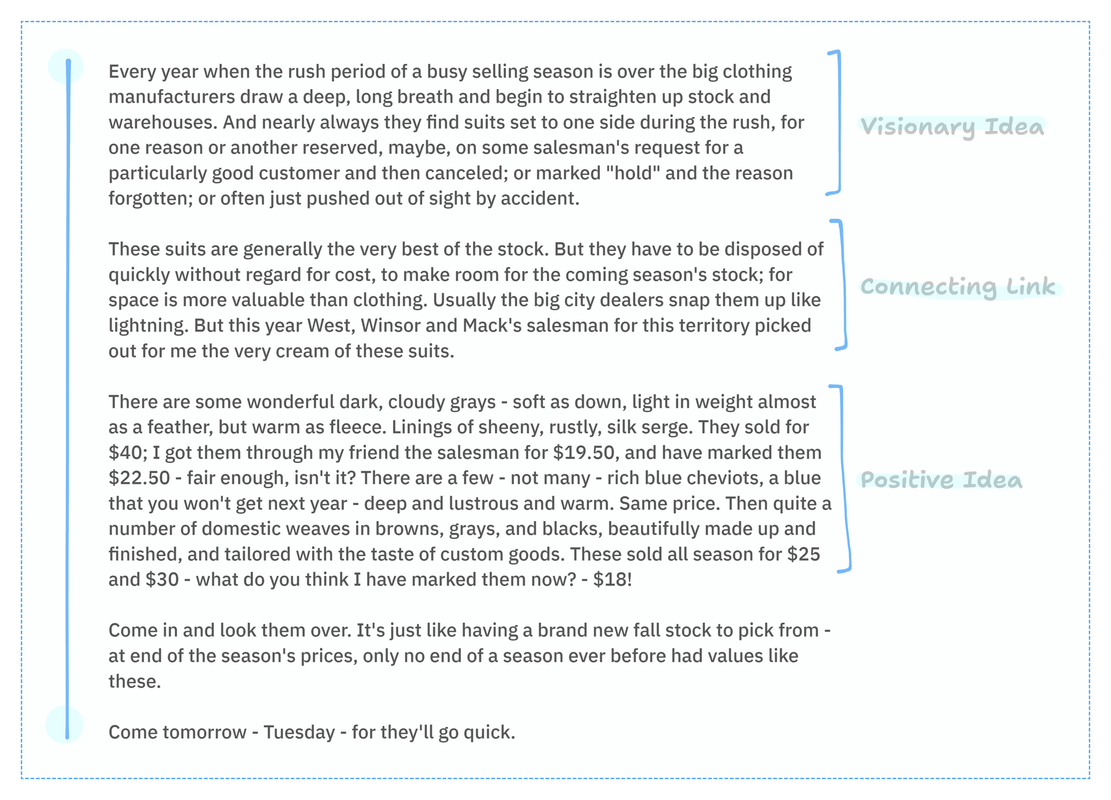 See how this letter uses the Visionary Idea? It works brilliantly when your reader is indifferent.
As you already know, this method comes from the 1922 book, Applied Business Correspondence. The book itself is pretty much unknown.
Yet, you see companies using this exact method - with a few tweaks - even today.
For instance, Amy Hoy has a similar framework called Pain-Dream-Fix. It's interesting, and I highly recommend you read this article on it.
I think you'll have a real "aha" moment when you see how the two methods connect.
[...]
We're stacking the bricks one by one. Stick with it, and by the end of this series, everything will be so much clearer. Everything will fall into place.
Enjoy your Monday and, as always, thanks so much for your attention.
—Saloni
P.S.
Even if your writing is technically "good," a lack of understanding kills it. The reader tunes out. They stop reading, and just like that you’ve lost their attention.
Tomorrow, we’ll break down how to sidestep this—it's easier than you think.
See you then.
ITP: Getting to Clarity (email 4 of 7)
Hey, it's Saloni...
Nice to see you made it to Part 4!
Today, we'll explore the "Understanding" part of the framework.
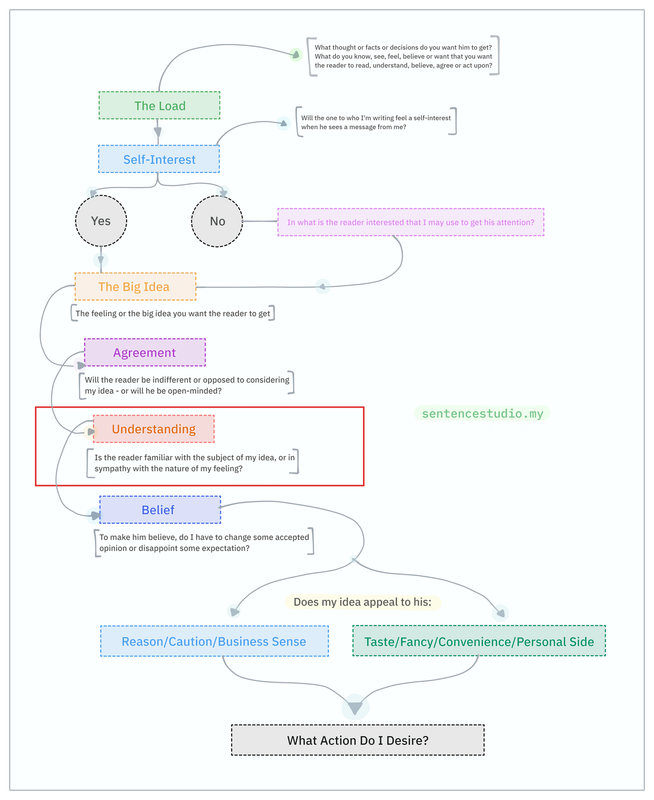
The reason we write is to share information or ideas.
However, if your writing isn’t crystal clear, your message is doomed. Sooner or later, the whole thing crumbles - and before you know it, you’ve lost your reader.
Clarity is what keeps them reading, keeps them engaged, and - most importantly - brings them back time and time again.
The visualization below explains how to make your writing clear, so the reader understands what you're trying to say:
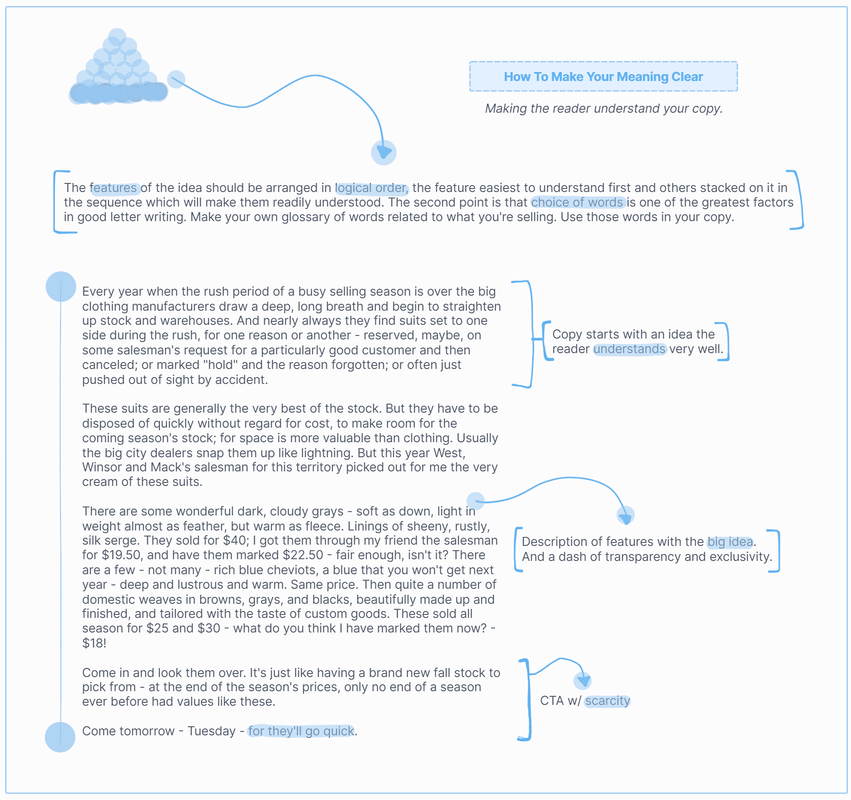
The features of your idea should be arranged in a logical order.
The easiest feature to understand goes first, with the others following in a sequence that makes them readily understood.
It's important to really get this right.
If you get everything else right but ignore understanding, nothing else matters. Making your meaning clear is the most fundamentally important part.
Anyhoo...
I hope this was useful.
[...]
In Part 5, we'll explore three methods for making your writing believable. Because if your audience doesn't believe you, they won't listen, they won't engage, and they certainly won't take action.
We'll also uncover a highly misunderstood aspect of writing that's secretly damaging your believability factor.
Until tomorrow...
—Saloni
P.S.
If you write copy for physical products - or even if you just want to write better - there's a webinar I think you'll love. One that was so fun to watch, it inspired me to delve deeper into the art of copywriting.
In it, Brad Hedeman shares his step-by-step process for writing compelling copy (specifically for food products at Zingerman's).
His approach is both specific and very easy to replicate. I'm sure you'll find this incredibly insightful.
Download the webinar files here:
Copy That!: Our Tips And Techniques For Writing Great Product Copy
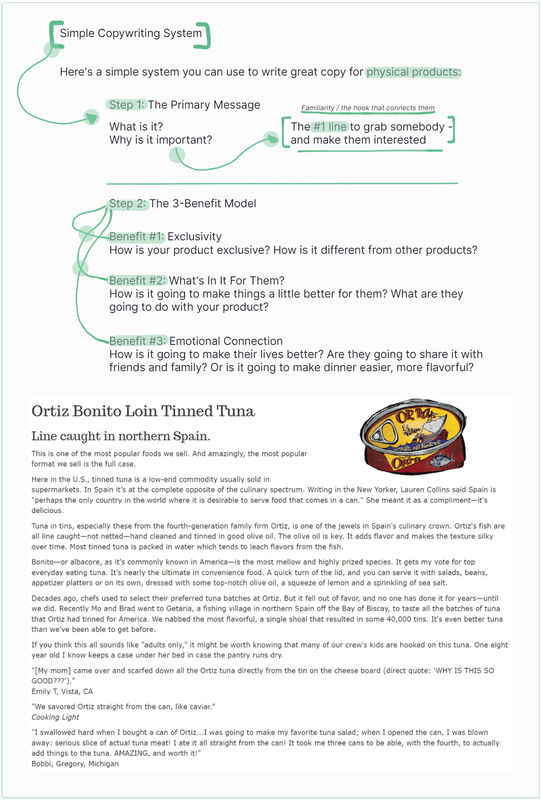 This is a quick summary I put together of the webinar.
ITP: Simple Steps to Sincerity (email 5 of 7)
Hey, it's Saloni...
Today, we're taking a look at writing from the perspective of believability.
There are two ideas we're going to explore that will completely change how you connect with your readers - and, crucially, how you earn trust.
 Without belief, your writing will not have the desired effect, no matter how well-written it is otherwise.
People are bombarded with messages all day long.
Messages are everywhere - and they're noisy.
So it's no surprise people have gotten really good at filtering things out. They can spot something that’s inauthentic from a mile away.
If your writing doesn’t ring true, if it doesn’t feel real, it just gets filtered out.
And that's a problem.
And when that happens, they click away - and go in search of someone who feels real.
[...]
That's the reason sincerity is important. It enables us to connect with readers and build the long-term relationships that define our purpose as writers.
Below, you'll find two powerful ideas to make your writing more sincere.
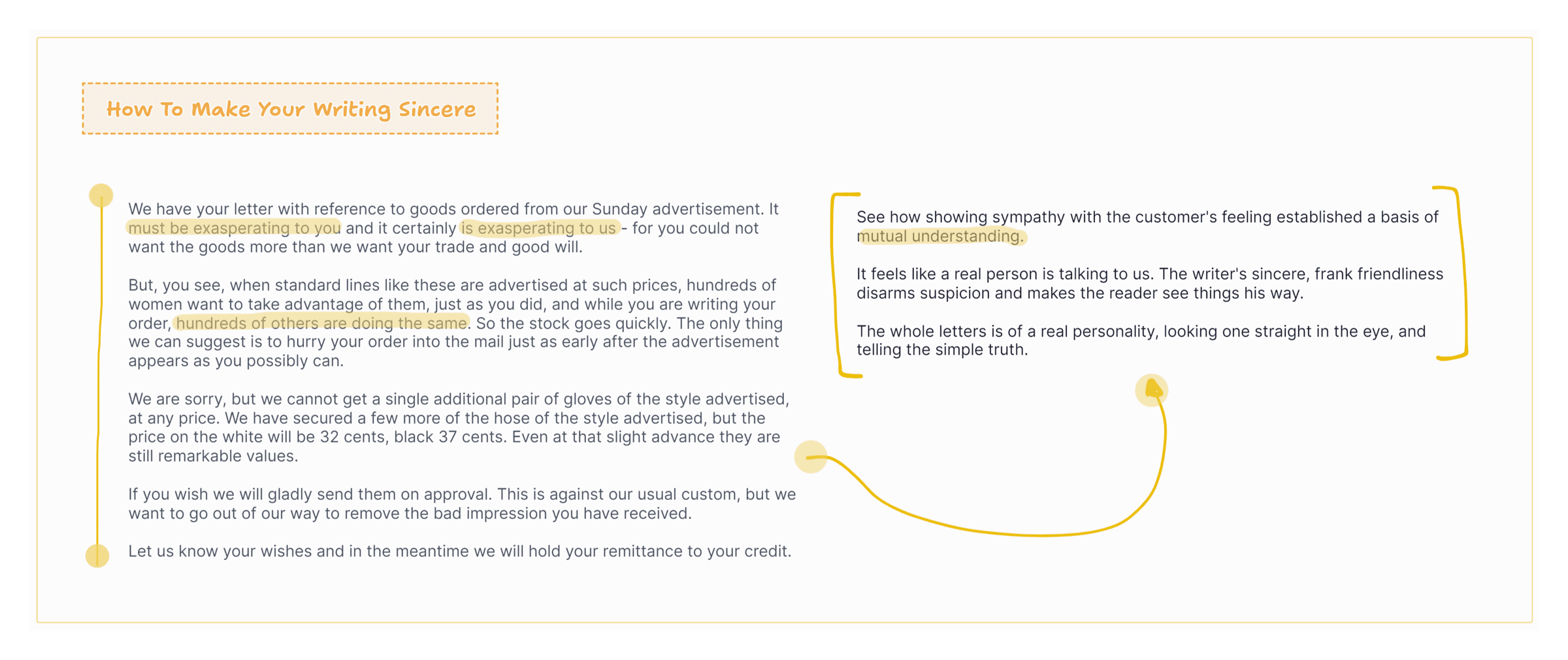 When you create a sense of mutual understanding, your writing becomes sincere (and, in turn, believable).
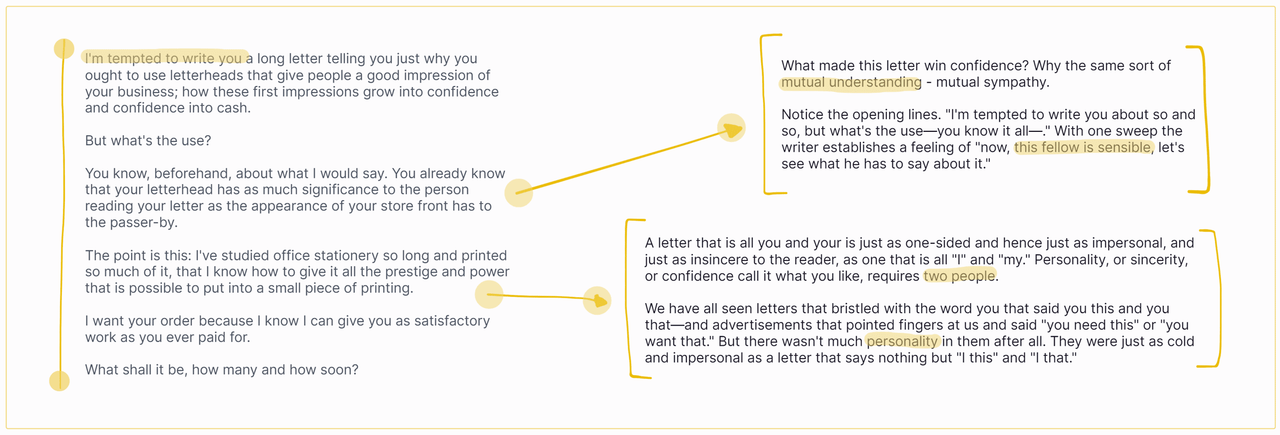 Many writers misunderstand this. They believe constant use of "you" is essential for reader engagement. The truth is, overuse of "you" makes your writing less believable. It makes it lack personality. And that's why it's important to find a balance between "you" and "I."
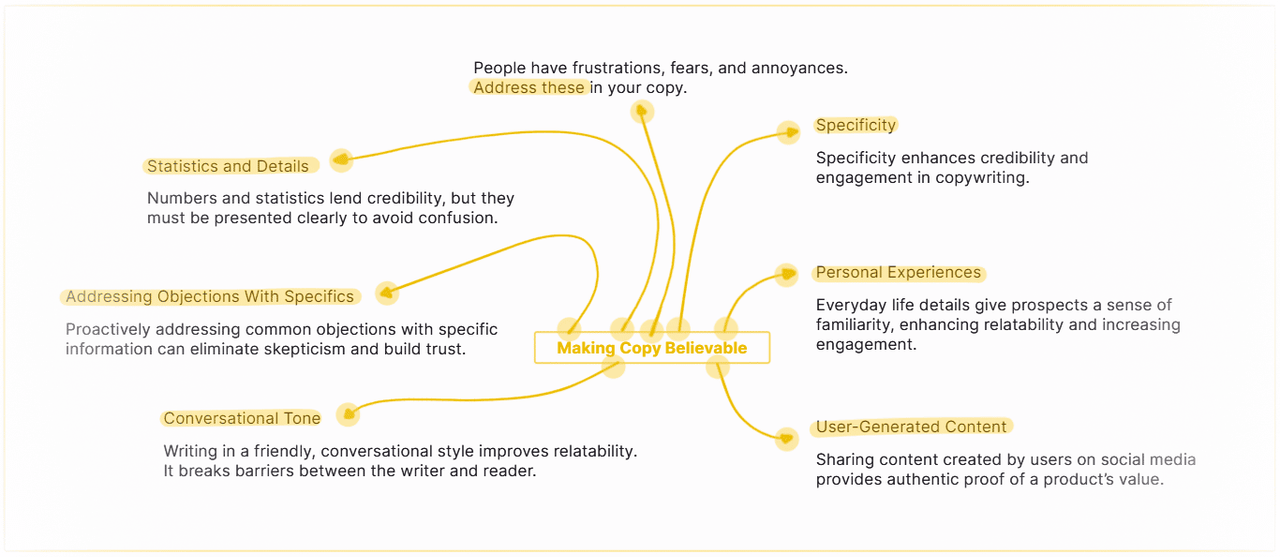 7 extra ways to make any piece of writing more believable.
I really hope you found this helpful.
Enjoy the weekend!
—Saloni
P.S.
If you write copy, I have a bonus visualization for you:
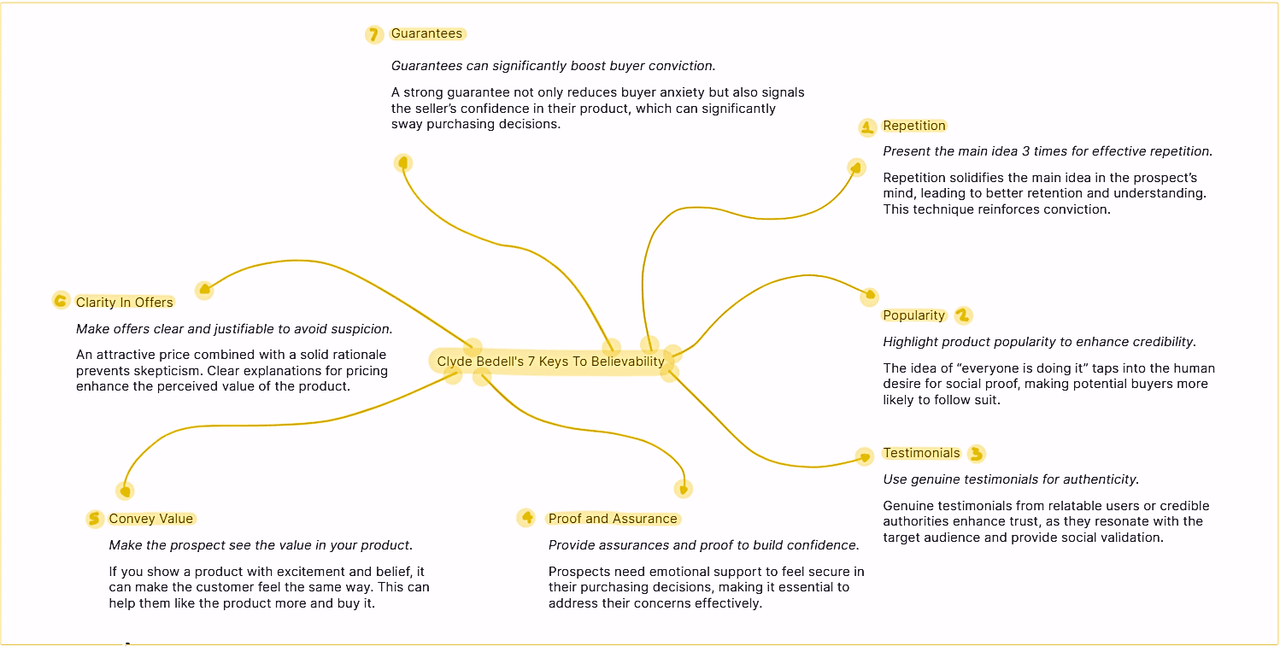 Clyde Bedell's seven-point checklist to make your copy believable.
ITP: 2+2 Persuasion (email 6 of 7)
Hey, it's Saloni...
Welcome to Part 6! 🎉
Today, we’re going to talk about persuasion - a topic I find particularly interesting.
(And this isn’t just for copywriters. You'll get why it matters - even if you write articles, blog posts, essays, non-fiction, or even just stuff for social media.)
Imagine you're writing a blog post about learning the guitar.
The first step is to understand what guitar students really want.
They might want to express their creativity, impress their friends, or simply enjoy the pleasure of playing music. These are their motives.
You then craft your writing to address those motives. You show them how your learning method will deliver those results.
This is persuasion - understanding what drives them, and crafting your message in a way that resonates.
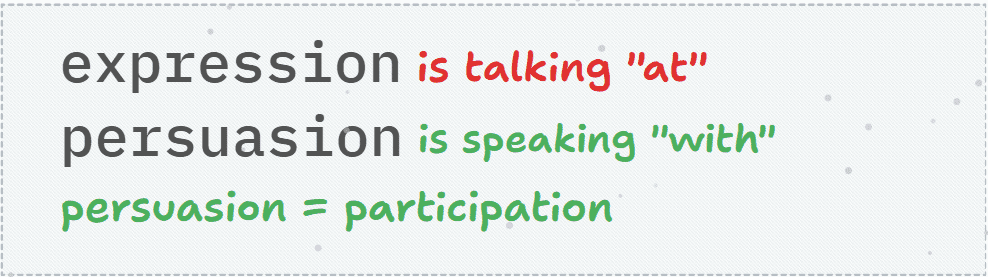
Amy Hoy's video, How to Write So People Give a Damn, explains this beautifully.
When you start using persuasion in your writing, you’ll begin to see a remarkable change in the way your readers engage with your work.
[...]
Below you'll find a series of visualizations about persuasion, each designed to be self-explanatory and easy to grasp. Take your time and explore each one at your own pace.
1/ Three visualizations on human motives (from six copywriting books):
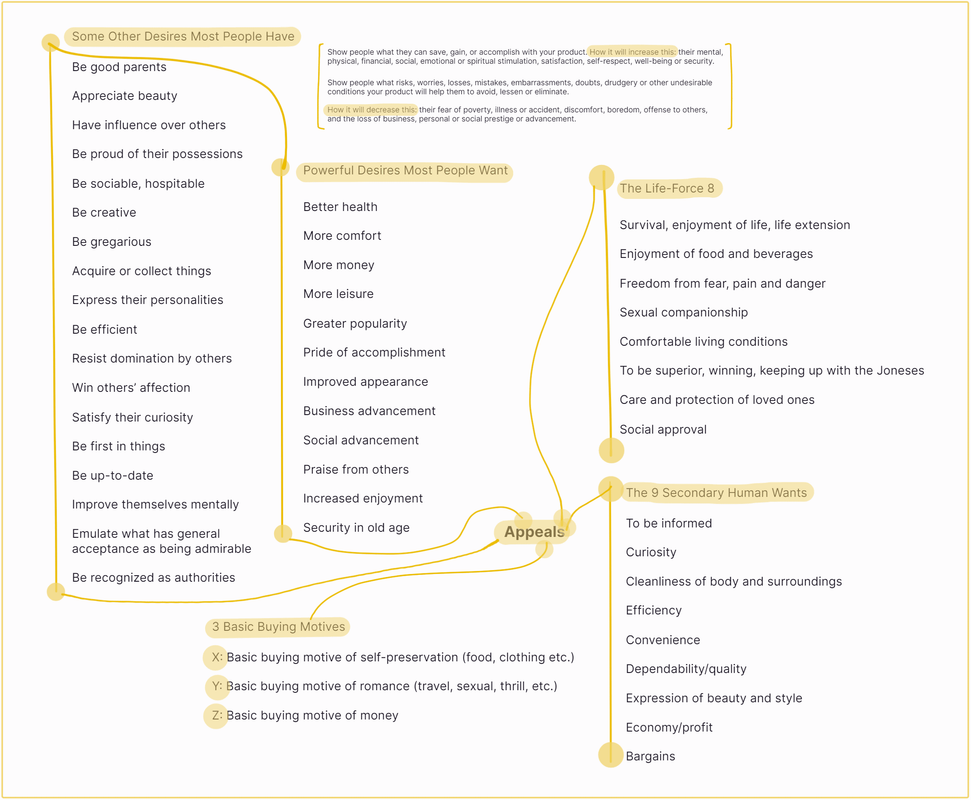 Understanding why someone would choose you—whether it's for a product, a service, or even to read your article or essay—is key. Without that understanding, guiding them toward a desired action becomes harder.
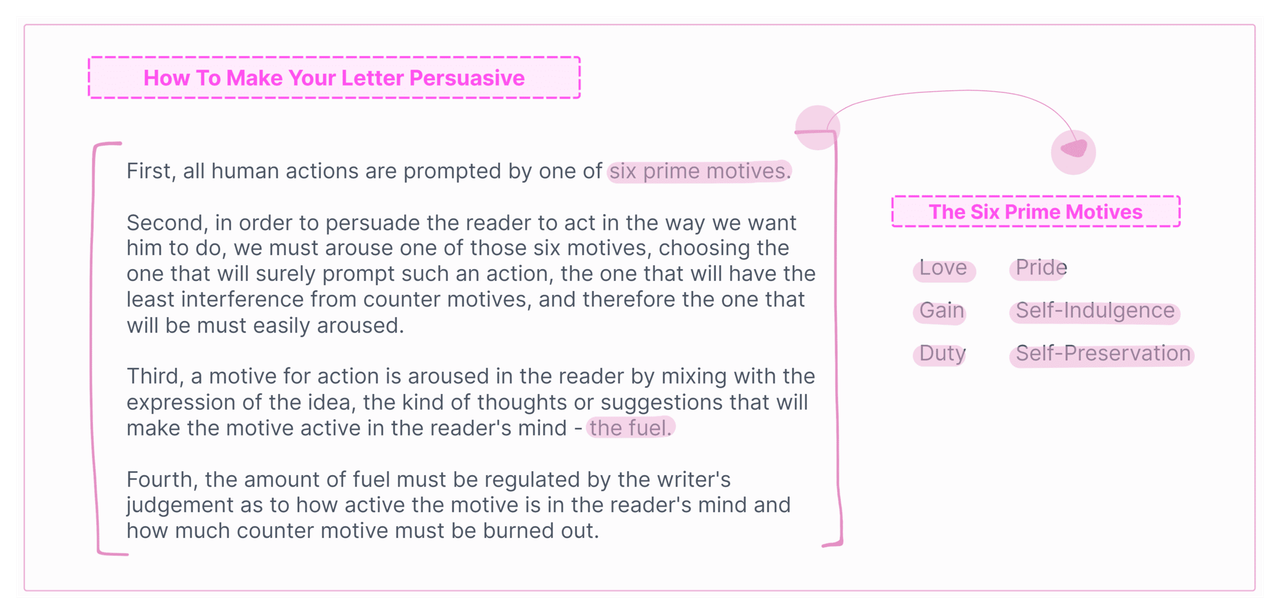 To persuade effectively, you must understand what motivates people.
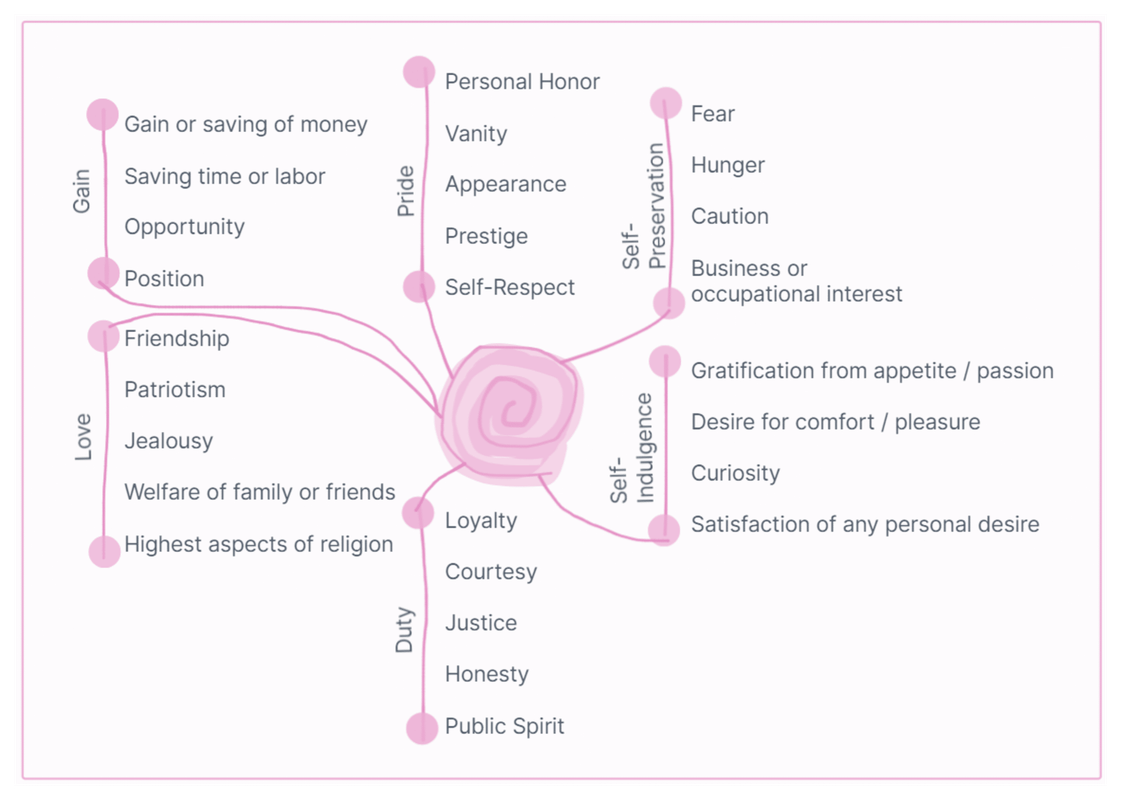 The Six Prime Motives
2/ To help you understand how this method works, here's an example:
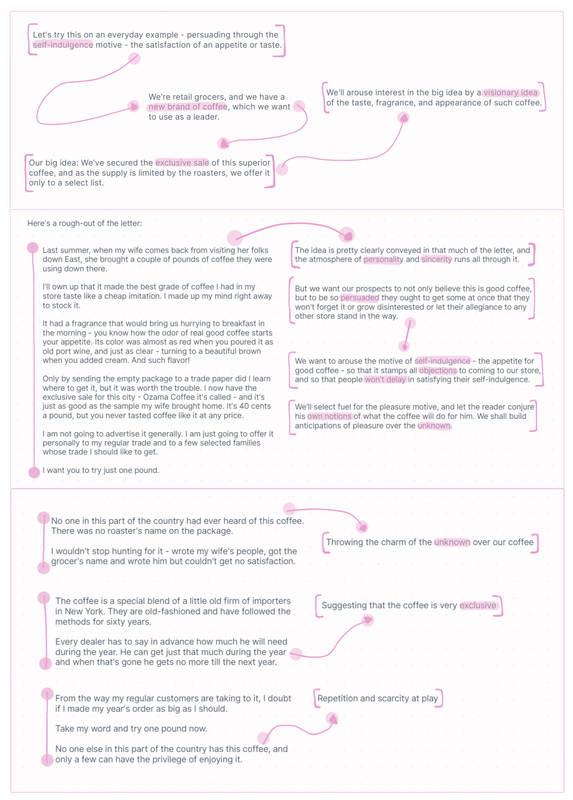 For an example of persuasion in action, look at how wonderfully the letter revolves around the big idea, arousing the motive of "self-indulgence."
Tomorrow, we'll explore a powerful method to get people to take action - in both writing and conversation. This is a method many skilled communicators use naturally, often without realizing the underlying principle.
Plus, you'll see a comprehensive, step-by-step example tying together everything we've covered so far.
See you tomorrow...
—Saloni
P.S.
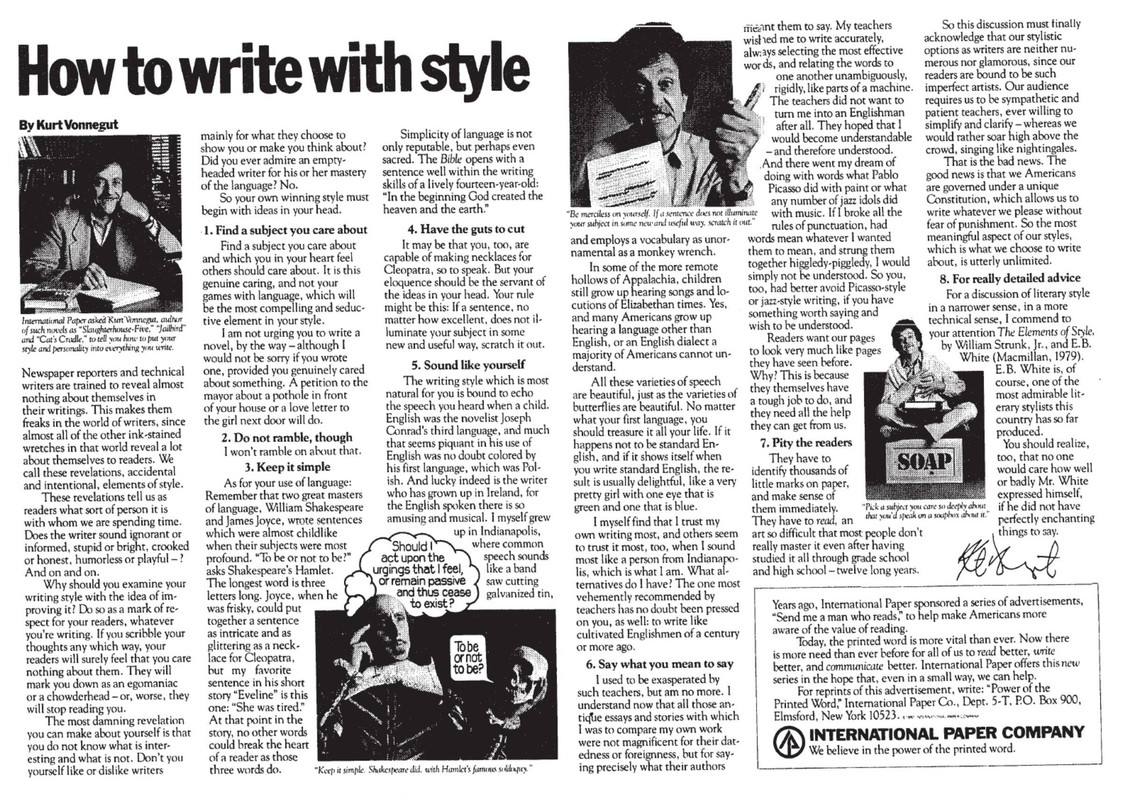 How to write with style, by Kurt Vonnegut.
ITP: Call To Action (email 7 of 7)
Hey, it's Saloni...
This is the final Ideas to Pages email. Previous parts are linked below for your review.
Part 1: The Missing Ingredient
Part 2: A Myth Called Writer's Block
Part 3: The Connecting Link
Part 4: Getting to Clarity
Part 5: Simple Steps to Sincerity
Part 6: 2+2 Persuasion
Here's a visualization showing you how to get your readers to act on something:
(While especially helpful for copy, this works for any call to action - getting readers to click, read, send, or buy).
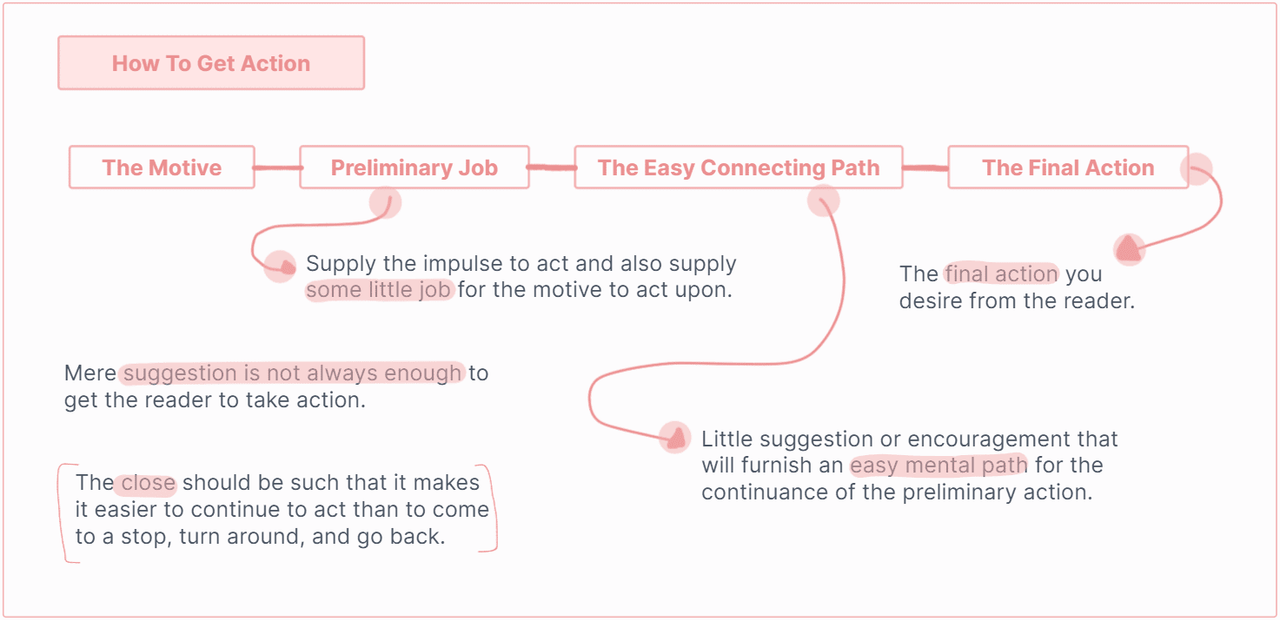 The complete, step-by-step method.
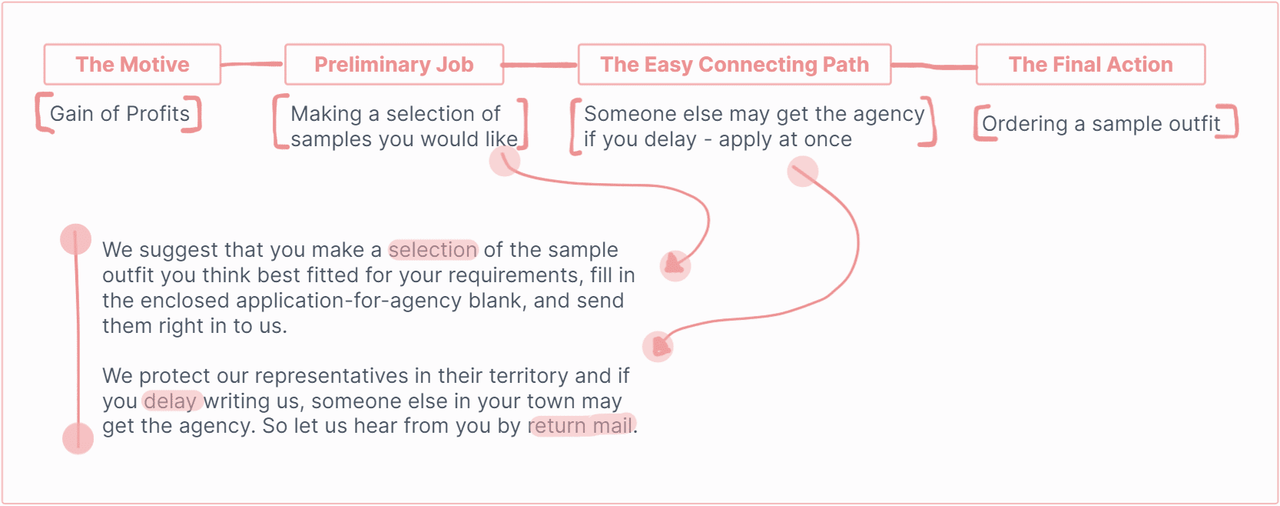 A quick example of how it all ties together.
We’ve spent some time exploring the individual parts of the Size Up Chart, examining each one with care. Now, the question becomes: how do they all work together?
There's an interesting example in the 1922 book Applied Business Correspondence that will tie everything together for you. In it, author explains - step by step - how to write a letter that gets people into a restaurant for free lemon pie.
That should be your next step after reading this email.
[...]
This ends our 7-part series. Thank you so much for your attention, it's always a real honor.
—Saloni
P.S.
If you've been with me on this journey, you might have noticed a gap.
A rather significant one, actually.
We've explored X, Y, and Z, but where is the key to gripping attention?
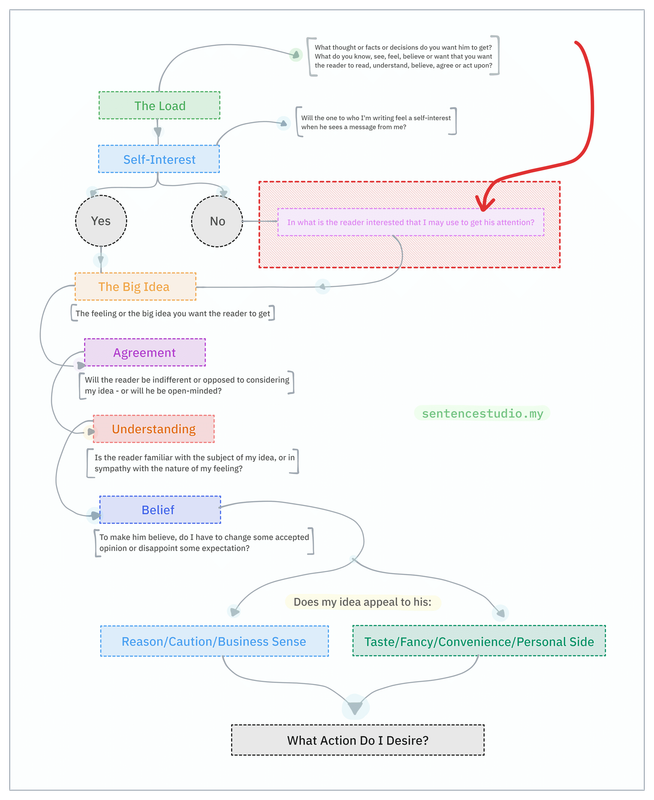 This is the missing piece of the puzzle. More details in the next email.